


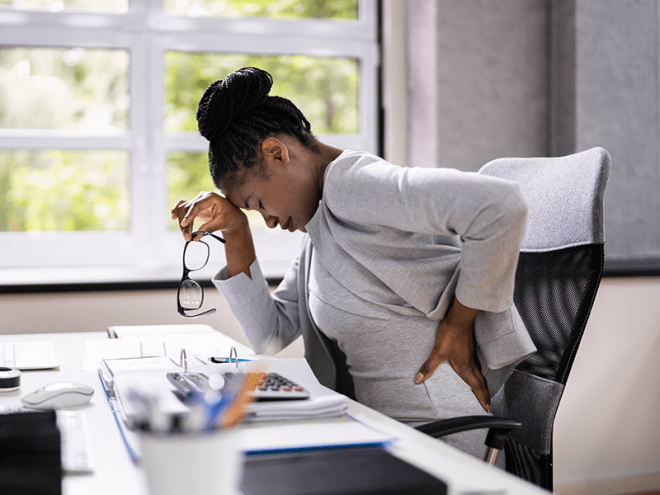
Low back pain is the single most common reason people walk into a chiropractic office — and the leading cause of disability worldwide. Most of it is mechanical, meaning it comes from the joints, discs, and muscles of the lumbar spine rather than from a disease. That is good news: mechanical pain responds well to treatment. The harder part is knowing which kind of low back pain you have, and which warning signs mean you should be evaluated right away.
Why the Low Back Takes So Much Abuse
Your five lumbar vertebrae carry the weight of everything above them while still allowing you to bend, twist, and lift. That combination — heavy load plus wide range of motion — is a demanding engineering problem, and the lumbar spine sits right at the point where a mobile spine meets a fixed pelvis. Any stiffness in the hips or mid-back tends to get absorbed by the low back instead, which is why the pain often shows up there even when the original problem started somewhere else.
The Most Common Causes
In the large majority of cases, low back pain traces back to one of a handful of mechanical sources:
- Joint restriction and muscle guarding — the classic “my back went out” episode, where a lumbar joint stops moving normally and the surrounding muscles clamp down to protect it
- Disc injury — a bulging or herniated disc pressing on nearby tissue, which often produces pain that worsens with sitting and bending forward
- Nerve root irritation — when a disc or bone spur crowds a nerve where it exits the spine, producing sciatica or other radiculopathy down the leg
- Degenerative change — arthritic wear in the facet joints, usually producing stiffness that is worst in the morning and after inactivity
- Postural and load-related strain — long hours seated, repetitive lifting, or a sudden increase in activity
These categories overlap constantly. A person with degenerative change is more likely to have a joint lock up, and a disc injury almost always brings muscle guarding with it. Part of a good examination is sorting out which piece is driving your current pain.
Red Flags: When Low Back Pain Needs Urgent Attention
Most low back pain is not dangerous, but a small number of presentations need medical evaluation before any conservative care begins. Seek prompt attention if your back pain comes with:
- Loss of bladder or bowel control, or numbness in the saddle region between the legs
- Progressive weakness in one or both legs, or a foot that drags or slaps when you walk
- Unexplained weight loss, fever, or night pain that wakes you and will not settle in any position
- A history of cancer, significant osteoporosis, or recent major trauma such as a fall from height or a car crash
These are uncommon, but they matter. A responsible examination screens for them first and refers out when something does not fit a mechanical pattern.
What Actually Helps
For ordinary mechanical low back pain, the evidence favors staying active and restoring normal motion over resting and waiting. Bed rest beyond a day or two tends to make things worse, not better. Care usually combines several pieces:
- Chiropractic adjustment to restore movement to the restricted lumbar and pelvic joints
- Soft-tissue work to release the protective muscle spasm that keeps the area locked down
- Specific exercise — usually hip mobility and trunk endurance rather than traditional sit-ups, which load the lumbar discs
- Load management — practical changes to how you sit, lift, and sleep while the tissue settles
How Long Should It Take to Feel Better?
A straightforward episode of mechanical low back pain typically improves meaningfully within two to six weeks, with the sharpest change often coming in the first week or two of care. Disc-related pain with leg symptoms is usually slower — think six to twelve weeks — and recovery tends to be stepwise rather than linear, with good days and setbacks mixed together. What matters more than the exact timeline is the direction: your pain should be becoming less frequent, less intense, or more localized over time. Pain that is not changing at all after several weeks of appropriate care is a signal to re-examine the diagnosis rather than simply continue.
Common Questions
Should I get an X-ray or MRI for low back pain?+
Usually not at first. Imaging is valuable when there are red flags, significant trauma, or neurological findings, or when pain has not responded to a reasonable course of conservative care. For a typical episode, imaging early tends to reveal age-related changes that are present in plenty of pain-free people, which can lead to treatment aimed at a picture rather than at your actual problem.
Is it safe to exercise while my low back hurts?+
In most cases yes, and it is usually better than resting. The goal is to find movement that does not provoke your pain pattern — walking is a good default for most people. What to avoid is pushing into sharp pain or loading the spine heavily while it is still irritable. Specific guidance depends on what is driving your pain, which is worth sorting out before you commit to a program.
Why does my low back hurt more when I sit than when I stand?+
Sitting, especially slouched sitting, increases pressure inside the lumbar discs and puts the low back into sustained flexion. Pain that is clearly worse with sitting and bending forward, and better with standing or walking, often points toward a disc-related source. The reverse pattern — worse standing and walking, better sitting or leaning on a cart — points more toward joint or canal-related causes.
The Bottom Line
Low back pain is common, usually mechanical, and usually treatable — but “usually” is not the same as “always,” which is why the first step is a proper examination rather than guessing. Identifying whether your pain is coming from a joint, a disc, a nerve, or arthritic change determines what will actually help, and rules out the small number of causes that need a different kind of attention.
If low back pain is limiting what you can do, we can find out why. Visit our low back pain page to learn more about our approach, or call 386-400-3620 or book an appointment online to get evaluated.
